
Note
Go to the end to download the full example code.
Units and unit conversion#
The cad.units field-data slot records the document unit on read
and write. units_conversion_factor returns the scalar to multiply
points by to reach a target unit, so an mm-defined part can move into
meters (for FEA) or inches (for US-customary CAM) without leaving the
pipeline.
This example reads a real mm-defined STEP part, the NIST AM Bench 2022 LPBF bridge specimen (public domain, https://doi.org/10.18434/mds2-2607), converts it to inches, and confirms the bounding box and volume scale accordingly.
import numpy as np
import pandas as pd
import pyvista as pv

import pyvista_cad
from pyvista_cad._metadata import units_conversion_factor
from pyvista_cad.examples import downloads
Read the real part. Verify the source unit.
mb = pyvista_cad.read_step(downloads.step_part_path())
mesh = mb.combine().extract_surface()
src_unit = str(mesh.cad.units) if mesh.cad.units else 'mm'
pd.DataFrame({'source_unit': [src_unit], 'bounds': [mesh.bounds]})
/home/runner/work/pyvista-cad/pyvista-cad/examples/04_metadata/units_and_conversion.py:31: PyVistaFutureWarning: The default value of `algorithm` for the filter
`UnstructuredGrid.extract_surface` will change in the future. It currently defaults to
`'dataset_surface'`, but will change to `None`. Explicitly set the `algorithm` keyword to
silence this warning.
  mesh = mb.combine().extract_surface()
Convert mm -> inch. The scalar factor is 1/25.4.
factor = units_conversion_factor(src_unit, 'inch')

converted = mesh.copy()
converted.points = converted.points * factor
converted.field_data['cad.units'] = np.array(['inch'])
pd.DataFrame(
    {
        'factor': [factor],
        'bounds_source': [mesh.bounds],
        'bounds_inch': [converted.bounds],
    }
)
Verify volumes scale by factor**3 (the volume invariant for
isotropic scaling).
pd.DataFrame(
    {
        'volume_ratio': [converted.volume / mesh.volume if mesh.volume > 0 else float('nan')],
        'expected': [factor**3],
    }
)
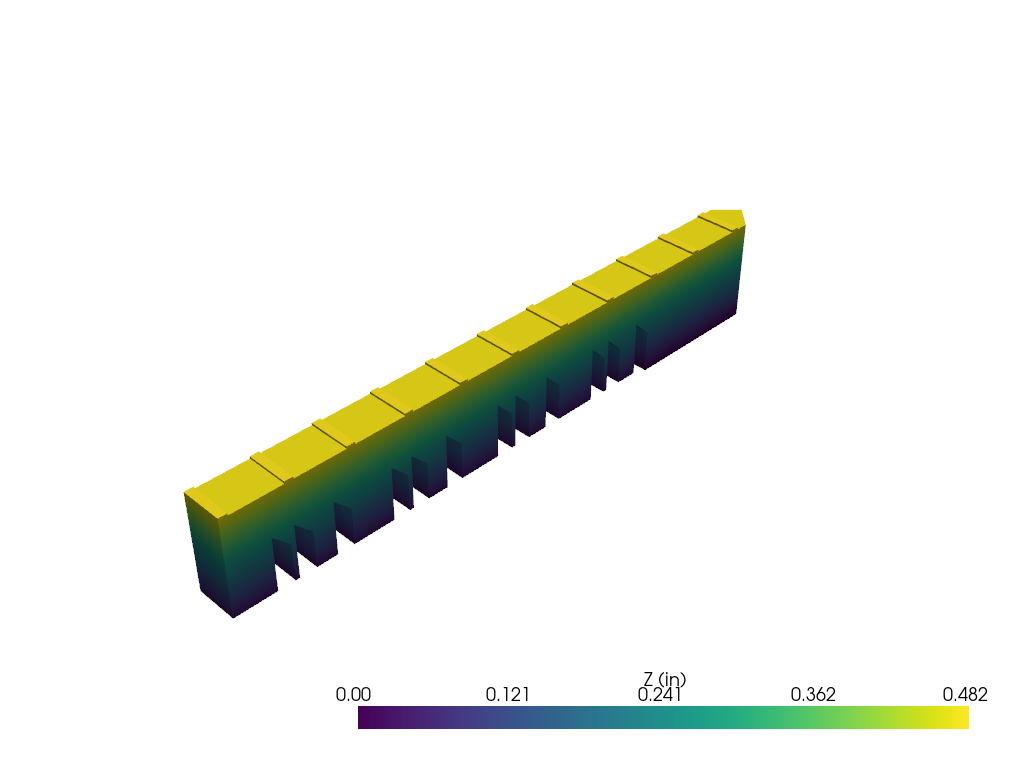
Render the converted mesh.
converted['Z (in)'] = converted.points[:, 2]
pl = pv.Plotter()
pl.cad.add(converted, scalars='Z (in)', cmap='viridis')
pl.show()
Total running time of the script: (0 minutes 0.266 seconds)