
Note
Go to the end to download the full example code.
Compile an OpenSCAD source file#
pyvista_cad.read_scad shells out to the openscad CLI, captures
the STL it emits, and returns it as a pyvista.PolyData. The
OpenSCAD binary must be installed and on PATH.
This example compiles a real OpenSCAD library, threads.scad by
Ryan A. Colyer (CC0, rcolyer/threads-scad), a
widely used parametric ISO metric fastener generator. Its top-level
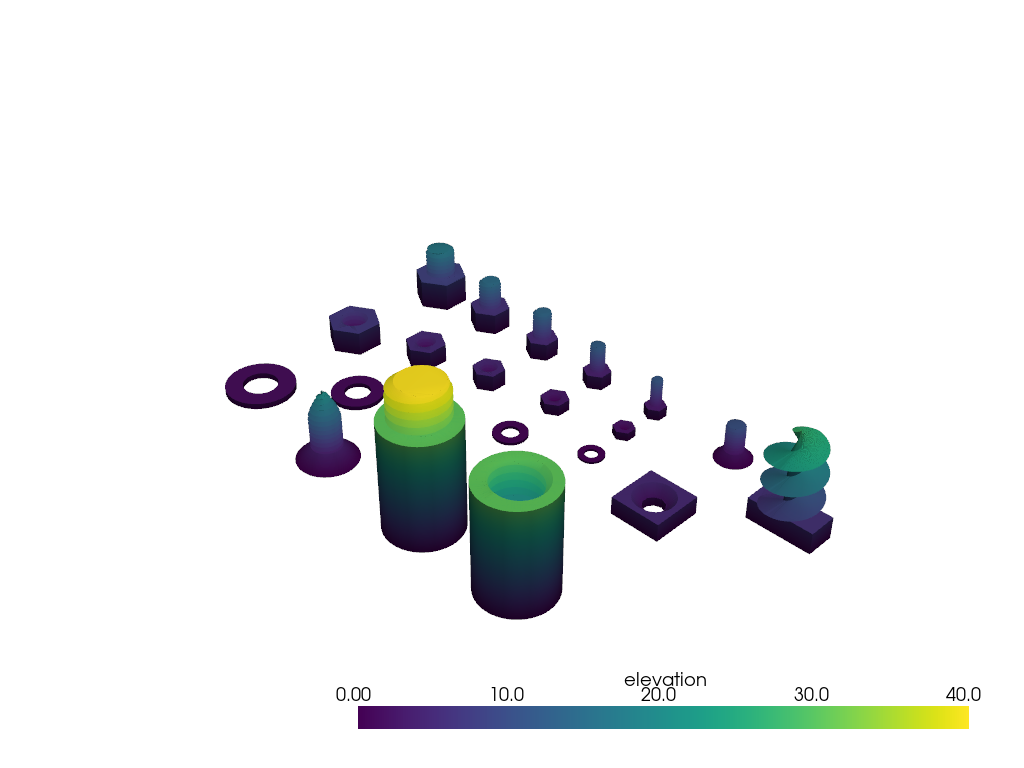
Demo() renders real bolts, nuts, and washers.
import pyvista as pv

import pyvista_cad
from pyvista_cad.examples import downloads
Compile the real .scad source. The openscad binary must be
installed and on PATH. threads.scad exposes a top-level
screw_resolution (mm); the default 0.2 tessellates the
helices very finely and is slow. -D screw_resolution=0.6 is
~3x faster and the thread features still read clearly: ample for
a gallery render. The fast manifold backend is applied
automatically (OpenSCAD >= 2024) with a fallback to CGAL.
mesh = pyvista_cad.read_scad(
    downloads.scad_threads_path(),
    args=('-D', 'screw_resolution=0.6'),
)
mesh
Render colored by Z so the fastener features read.
mesh['elevation'] = mesh.points[:, 2]

pl = pv.Plotter()
pl.cad.add(mesh, scalars='elevation', cmap='viridis')
pl.show()
Total running time of the script: (0 minutes 47.157 seconds)